Gambling Disorder — I’m Trying to Understand
An accessible, evidence‑informed overview of gambling disorder — what it is, how it develops, and why it matters.
Why understanding matters
Whether you’re a student, researcher, journalist, policymaker, concerned family member, or simply curious about behavioral health, developing an informed understanding of gambling disorder serves several important purposes.
Understanding reduces stigma. When gambling disorder is recognized as a neurobiological condition rather than a moral failing, it creates space for compassion and more effective responses. Understanding also informs prevention: knowledge of risk factors and underlying mechanisms helps shape better public health strategies and protective policies. Finally, understanding improves recognition, allowing problematic patterns to be identified earlier and support to be accessed sooner.
This page offers an accessible overview grounded in scientific evidence, current diagnostic frameworks, and peer‑reviewed research. The goal is to present accurate information while respecting both the complexity of the condition and the dignity of those affected by it.
What is gambling disorder?
Gambling disorder is a behavioral addiction characterized by persistent and recurrent problematic gambling behavior that leads to significant distress or impairment. Unlike recreational gambling, it involves a loss of control over gambling activities, ongoing preoccupation with gambling, and continuation despite negative consequences.
Gambling disorder is formally recognized in both the DSM‑5‑TR (Diagnostic and Statistical Manual of Mental Disorders, Fifth Edition, Text Revision) and ICD‑11 (International Classification of Diseases, 11th Revision). In these frameworks, it is grouped with substance use disorders because of shared neurobiological processes, overlapping clinical features, and similar responses to treatment.
Importantly, gambling disorder exists on a spectrum. Many people gamble recreationally without harm, while others develop patterns of gambling that gradually interfere with emotional well‑being, relationships, finances, and daily functioning.
Key distinguishing features
People with gambling disorder may experience several of the following patterns over time:
- Loss of control over gambling behavior
- Persistent preoccupation with gambling activities
- Needing increasing amounts to achieve the desired excitement (tolerance)
- Repeated unsuccessful efforts to cut back or stop
- Restlessness or irritability when unable to gamble
- Using gambling to escape problems or regulate mood
- Chasing losses (returning to gamble in an attempt to recover money)
- Meaningful impairment in work, relationships, finances, or health
Not all features are present in every individual, and severity can vary.
The spectrum of gambling behavior
Gambling behavior can be understood as existing along a continuum, ranging from no gambling, to recreational gambling, to increasingly problematic patterns, and in some cases to gambling disorder. Viewing gambling behavior this way helps clarify that most people who gamble do not develop a disorder, and that gambling‑related harm varies widely in both form and severity.
Recreational gambling
- Occasional gambling undertaken primarily for entertainment
- Clear, self‑imposed limits on time and money
- No meaningful negative consequences
- Gambling remains one of many leisure activities
At‑risk or problematic gambling
- More frequent gambling accompanied by emerging negative consequences
- Difficulty maintaining intended limits
- Early interference with daily responsibilities or well‑being
- Harm may occur even without meeting formal diagnostic criteria
Gambling disorder
- A sustained pattern of gambling behavior that meets established diagnostic thresholds
- Significant impairment across multiple areas of life
- Persistent loss of control over gambling
- Professional support is often helpful at this stage
Movement along this continuum can occur in either direction. Some individuals progress toward more severe gambling‑related harm over time, while others—particularly with early support or natural recovery—move back toward controlled or no gambling. There is no single trajectory, and patterns of change vary considerably between individuals.
The neuroscience of gambling disorder
Over the past two decades, research has helped clarify how gambling disorder is associated with changes in brain systems involved in reward, motivation, and self‑control. Rather than a single abnormality, the condition reflects a pattern of altered brain responses that shape how rewards are anticipated, decisions are made, and impulses are regulated.
How rewards are processed differently
One way researchers understand gambling disorder is through changes in how the brain processes reward. Neuroimaging studies suggest that dopamine signaling in reward‑related regions—particularly the ventral striatum—responds differently during anticipation of gambling outcomes, especially potential wins.
The dopamine system evolved to reinforce behaviors important for survival, such as seeking food or social connection. Gambling activities can strongly engage this system, sometimes more intensely than everyday rewards. Over time, the brain may adapt to repeated stimulation, leading to diminished response to smaller rewards and a tendency to seek greater intensity to achieve the same subjective effect. This process helps explain why gambling can escalate even when enjoyment decreases.
Decision‑making and impulse control
Gambling disorder is also associated with changes in brain regions involved in decision‑making and impulse regulation. Functional imaging studies suggest reduced engagement of prefrontal areas that support inhibiting impulses, weighing long‑term consequences, and adjusting behavior in response to negative outcomes.
In particular, the ventromedial prefrontal cortex (vmPFC)—a region important for evaluating future consequences and guiding self‑control—often shows altered activation patterns. This helps explain why simply “deciding to stop” is more complex than an issue of motivation or willpower alone.
How near misses affect the brain
Research on gambling mechanics, especially slot machines, has highlighted the powerful role of near misses—outcomes that closely resemble a win but are objectively losses. Brain imaging studies suggest that near misses can activate reward pathways in ways similar to actual wins.
As a result, the brain may interpret these events as encouraging signals rather than negative feedback. This helps explain why play is sustained even in the face of repeated losses, particularly when losses are presented in ways that feel psychologically rewarding.
Genetic and biological influences
Studies of twins and families suggest that genetic factors contribute meaningfully to vulnerability for gambling disorder, accounting for an estimated portion of overall risk. Variations in genes related to dopamine, serotonin, and other neurotransmitter systems appear to influence how individuals respond to rewards, stress, and impulses.
Genetic vulnerability does not mean gambling disorder is inevitable. Rather, it reflects differences in biological sensitivity that interact with environmental factors, exposure, and learning over time.
Risk factors and protective factors
Research suggests that gambling disorder tends to emerge from the interaction of multiple risk factors rather than from any single cause. Understanding these influences can inform prevention efforts and help identify situations where early support may be especially helpful. Importantly, the presence of risk factors does not mean that a disorder will develop, just as their absence does not guarantee protection.
Genetic and biological influences
Some individuals appear to have biological vulnerabilities that affect how rewards, impulses, and stress are processed. These may include a family history of gambling disorder or substance use disorders, genetic variations related to reward sensitivity, and differences in brain systems involved in impulse control. Co‑occurring mental health conditions—such as attention‑deficit/hyperactivity disorder (ADHD), mood disorders, or substance use disorders—can further increase vulnerability.
Developmental influences
Early life experiences can shape later gambling behavior. Exposure to gambling during adolescence, especially when paired with early wins or “big wins,” may create strong learning effects. Childhood trauma or other adverse experiences can also increase vulnerability, as can growing up in environments where gambling is normalized or actively encouraged.
Environmental influences
The broader environment plays an important role. High availability of gambling opportunities, frequent exposure to advertising or promotions, and social settings where gambling is common all increase risk. Certain occupations or social roles—such as work in gambling venues or participation in high‑stakes competitive environments—may involve repeated exposure that reinforces gambling behavior.
Psychological influences
Individual differences in temperament and coping style also matter. Traits such as impulsivity or sensation‑seeking, difficulty tolerating negative emotions, and cognitive distortions about chance or control can all contribute to risk. Gambling may become particularly reinforcing when it is used as a primary way to manage stress, boredom, or emotional distress.
Cultural and social influences
Cultural attitudes toward gambling, levels of social connection, and access to alternative forms of recreation shape risk in meaningful ways. Social isolation, financial strain, or environments where gambling is widely accepted or encouraged can amplify vulnerability, especially when combined with other risk factors.
Protective factors
Protective factors can reduce risk and support healthier outcomes. These include strong social support networks, a range of coping strategies and leisure activities, financial literacy and stability, access to mental health care, and awareness of early warning signs. Protective factors do not eliminate risk, but they can meaningfully buffer against harm.
Consequences across life domains
Gambling disorder affects far more than finances alone. Over time, its consequences can extend across many areas of life, often interacting in ways that intensify stress and make change more difficult. These effects vary in severity, but even moderate gambling problems can create meaningful disruption.
Financial strain and instability
Financial consequences are often the most visible. Individuals may accumulate substantial debt, fall behind on loans, or exhaust savings and retirement accounts. Borrowing from multiple sources, selling personal assets, or relying on others for financial support is common. In some cases, attempts to finance gambling or recover losses lead to illegal behavior, resulting in legal and financial repercussions. These stresses frequently affect not only the individual, but partners, children, and extended family.
Relationship disruption
Gambling problems place significant strain on relationships. Secrecy about gambling activity, financial losses, and broken commitments erodes trust over time. Intimate partnerships may deteriorate, and conflict around money and responsibility often increases. Parent–child relationships can be affected when gambling interferes with emotional availability or family resources. As shame and isolation grow, social networks may narrow further.
Occupational and educational impact
Preoccupation with gambling can interfere with concentration, reliability, and performance at work or school. Absenteeism may increase, productivity may decline, and opportunities for advancement can be lost. Some individuals experience job loss due to impaired performance, gambling during work hours, or financial misconduct. Financial stress related to gambling can further compound workplace pressure.
Mental health effects
Gambling disorder frequently co‑occurs with, or contributes to, mental health difficulties such as depression and anxiety. Many individuals describe a cycle of anticipation, short‑lived relief, disappointment, guilt, and despair. Over time, this emotional burden can become overwhelming. Rates of suicidal thoughts and attempts are higher among individuals with gambling disorder compared to the general population, underscoring the seriousness of its psychological impact.
Physical health consequences
Chronic stress associated with gambling‑related problems can affect physical health. Research links gambling disorder to higher rates of sleep disturbance, cardiovascular risk factors, and stress‑related conditions. Self‑care may decline as attention becomes focused on gambling or its consequences, and health concerns may go untreated due to financial strain or avoidance.
Legal and civic consequences
In some cases, gambling‑related behaviors lead to involvement with the legal system. This may include criminal charges related to financial misconduct, as well as civil legal issues such as creditor lawsuits, divorce proceedings, or loss of professional licensure. Legal consequences can persist long after gambling behavior has stopped, adding to long‑term stress and recovery challenges.
Common myths about gambling disorder
Misunderstanding and stigma surrounding gambling disorder remain common. Addressing widely held myths can help foster more accurate, compassionate perspectives and reduce barriers to recognition and support.
Gambling disorder is just a lack of willpower or self‑control.”
Gambling disorder is associated with measurable changes in brain systems involved in reward, motivation, and impulse regulation. While choices and behavior play a role, these neurobiological processes make “just stopping” far more complex than a simple matter of willpower. It reflects a health condition, not a character flaw.
Only irresponsible or weak people develop gambling problems.
Gambling disorder affects people across all backgrounds, intelligence levels, professions, and socioeconomic circumstances. Many individuals who develop gambling disorder function responsibly and successfully in other areas of life. Vulnerability relates to a combination of biological, psychological, and environmental factors—not moral character.
Gambling disorder only matters if a lot of money is lost.
The defining issue is not the total amount of money lost, but loss of control and resulting harm. Gambling disorder can involve relatively small financial amounts yet still cause significant disruption to relationships, work, mental health, or overall functioning.
People with gambling disorder gamble every day.
Gambling patterns vary widely. Some people gamble frequently, while others gamble intermittently or in episodes. Frequency alone does not determine severity; loss of control, preoccupation, and consequences are more informative indicators.
Gambling disorder only affects the person who gambles.
The effects of gambling disorder often extend well beyond the individual. Partners, children, and other family members may experience financial strain, erosion of trust, emotional distress, and relationship disruption. Employers, creditors, and communities may also be affected.
There’s nothing you can do about gambling disorder.
Gambling disorder is treatable. Research supports multiple effective approaches, including cognitive behavioral therapy, motivational interviewing, certain medications, and peer support. Many people experience meaningful and sustained improvement. Some individuals recover without formal treatment, but professional support often improves outcomes.
How common is gambling disorder?
0.4–2%
of adults meet criteria for gambling disorder in their lifetime globally
2–4×
higher rates among adolescents and young adults compared to general adult population
~68%
are male, though women progress more rapidly from recreational gambling to disorder
<10%
of individuals with gambling disorder ever seek formal treatment
~35%
experience natural recovery without formal intervention
75%+
have at least one co-occurring mental health condition
Estimates derived from DSM‑5‑TR diagnostic frameworks, national epidemiological surveys, and peer‑reviewed systematic reviews. Prevalence varies by region, study design, and diagnostic criteria.
Recovery is possible
A central finding across decades of research is that gambling disorder is not a permanent or irreversible condition. Many people experience meaningful improvement over time, and a range of pathways toward recovery have been documented. Outcomes vary widely, but change is both possible and common.
Treatment-Assisted Recovery
Research supports several effective approaches for gambling disorder. Cognitive behavioral therapy (CBT) has the strongest evidence base and focuses on understanding triggers, addressing unhelpful patterns of thinking, managing urges, and developing alternative coping strategies. Motivational interviewing (MI) is often used to help individuals clarify goals and resolve ambivalence about change.
Some medications—particularly opioid antagonists such as naltrexone—have been shown in clinical trials to reduce gambling urges and behavior for certain individuals. Peer‑based supports, including Gamblers Anonymous, may offer community, structure, and accountability, though experiences with these programs vary.
Treatment can take many forms, including individual or group therapy, brief interventions, guided self‑help materials, and online programs. Many people benefit from approaches that also address co‑occurring mental health conditions or substance use concerns.
Natural Recovery
Population studies also show that a substantial proportion of individuals reduce or stop problematic gambling without formal treatment. This process, often referred to as natural recovery, may be associated with changes in life circumstances, shifting priorities, or the development of alternative sources of meaning and satisfaction.
Protective factors linked to natural recovery include strong social support, stable employment, financial security, and the absence of severe co‑occurring conditions. At the same time, many individuals experience persistent or recurring difficulties, which helps explain why access to effective treatment remains important.
There is no single recovery path. Some people achieve lasting change after an initial intervention, while others experience periods of relapse before improvement stabilizes. Some aim for abstinence from gambling, while others focus on regaining control and reducing harm. Across these varied trajectories, one consistent finding emerges: improvement is possible, and many people find that persistence leads to better outcomes over time.
Similarities and differences with substance use disorders
The reclassification of gambling disorder in the DSM‑5—from an impulse‑control disorder to an addictive disorder—reflects growing evidence of meaningful overlap with substance use disorders. Examining both the similarities and the differences helps clarify what gambling disorder is, and what makes it distinct.
Shared features
-
- Changes in dopamine‑mediated reward processing
-
- Development of tolerance, with increasing intensity needed to achieve the same effect
-
- Withdrawal‑like experiences when stopping, such as restlessness or irritability
-
- Loss of control despite repeated attempts to cut back
-
- Preoccupation and craving
-
- Continuation of behavior despite clear negative consequences
-
- Elevated relapse risk over time
-
- Genetic and biological vulnerability factors
-
- Response to overlapping treatment approaches
- Increased risk of suicidal thoughts and behaviors
Important Differences
-
- No ingestion of an external substance and no direct neurotoxic effects
-
- No medically dangerous withdrawal syndrome requiring detoxification
-
- Physical health consequences arise indirectly, rather than from the behavior itself
-
- Reinforcement patterns differ, with variable and intermittent rewards playing a central role
-
- The near‑miss phenomenon is unique to gambling
-
- Financial loss is the primary tangible harm
-
- Opportunities to gamble are often more socially normalized and widely accessible
-
- Cultural and legal acceptance differs from that of most substances
-
- Treatment‑seeking rates tend to be lower than for substance use disorders
- Relapse triggers often involve financial stress, emotional states, or environmental cues such as advertising
Cultural and environmental context
Gambling disorder does not develop in isolation. Broader cultural attitudes, regulatory environments, industry practices, and technological changes all influence how gambling is experienced, how widely it is available, and how problems emerge and are recognized.
Accessibility and Normalization
Over the past several decades, gambling opportunities have expanded dramatically. Casino proliferation, online gambling platforms, and sports betting applications have increased accessibility to levels previously unseen. Activities that once required travel to specific venues are now available continuously on personal devices.
Research suggests that greater accessibility is associated with higher rates of gambling‑related harm. Online gambling, in particular, has been linked to faster progression from recreational use to problematic patterns.
Product Design and Marketing
Modern gambling products are shaped by extensive behavioral research. Features such as variable and intermittent reward schedules, near‑miss outcomes, rapid event frequency, and immersive sensory design are known to increase engagement and persistence. Marketing practices influence exposure and participation patterns, and in some contexts may disproportionately reach individuals who are already vulnerable.
Cultural Attitudes
Cultural and religious views on gambling vary widely across societies and communities. These attitudes influence prevalence, stigma, and help‑seeking behavior.
Regulatory Environment
Public policy approaches to gambling range from prohibition to widespread legalization with varying levels of regulation. Evidence suggests that public‑health‑oriented regulatory frameworks—such as age restrictions, limits on availability, advertising controls, and dedicated funding for prevention and treatment—are associated with differences in population‑level outcomes.
Prevention approaches
From a public health standpoint, preventing gambling disorder involves addressing risk at multiple levels—from individual awareness to broader environmental and policy contexts. Rather than a single solution, prevention efforts tend to combine education, early recognition, supportive services, and structural safeguards.
Universal Prevention
Universal approaches are aimed at the general population. These efforts focus on increasing awareness of gambling‑related risks, promoting financial literacy, encouraging critical thinking about gambling advertising, and fostering diverse leisure activities. School‑based programs and public awareness initiatives may help normalize early recognition and reduce stigma.
Selective Prevention
Selective prevention targets groups known to face higher risk, such as adolescents, individuals with a family history of gambling problems, those with certain mental health conditions, or people with occupational exposure to gambling environments. Approaches may include targeted education, screening, and early support services. Voluntary self‑exclusion programs are one example of a selective strategy designed to reduce exposure.
Indicated Prevention
Indicated prevention focuses on individuals showing early signs of gambling‑related harm but who do not yet meet criteria for gambling disorder. Brief interventions, structured self‑help resources, low‑barrier counseling, and financial guidance may help interrupt progression.
Environmental and Policy Approaches
Population‑level prevention also involves the environments in which gambling occurs. Research suggests that availability, marketing practices, product design features, and consumer protections shape overall risk. Regulatory approaches that emphasize harm reduction are associated with differences in population‑level outcomes.
Evidence Base
Information on this page reflects current diagnostic frameworks (DSM‑5‑TR and ICD‑11), large‑scale epidemiological studies, systematic reviews, and peer‑reviewed research on gambling disorder, behavioral addictions, and public health approaches. The content is intended to summarize established findings while acknowledging that estimates and interpretations may vary across studies and regions.
Scope and limitations
This page is designed for general educational purposes. It does not provide medical, psychological, or legal advice, and it is not intended to diagnose any condition. Individual experiences with gambling and recovery vary widely, and population‑level information may not reflect any single person’s situation.
Closing note
We hope this overview has been helpful in clarifying how gambling disorder is understood and why it matters. The goal of this page is to provide context and perspective, not answers or directives.
Go Deeper — The History & Science of Gambling Disorder
For readers who want to explore the full historical arc, the development of diagnostic thinking, and the evidence base in greater depth. These modules are optional — the core information above stands on its own.
📊 Gambling Across History: From Ritual to Behavioral Addiction — A 5,000-Year Journey
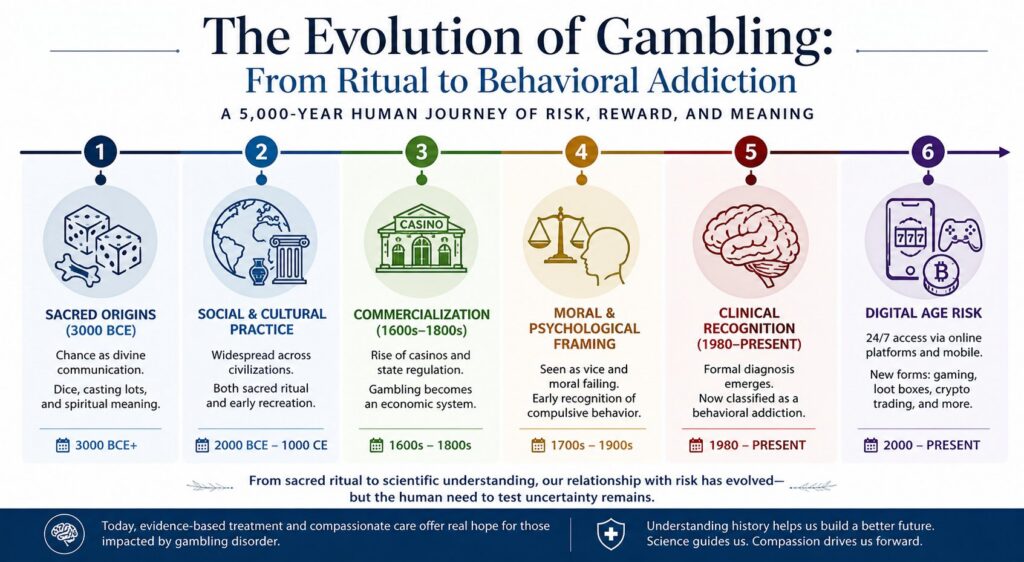
Opening Orientation
Why gambling disorder matters — and why history is clinically relevant.
Sacred Origins: Divination & the Dawn of Gambling
Chance as sacred practice — from casting lots to early dice across ancient civilizations.
Cultural & Social Integration
How gambling became embedded in social life across cultures and centuries.
Institutionalization: The Casino Model
The Ridotto, the house advantage, and the birth of commercial gambling.
From Vice to Disorder: Moralization & Early Psychopathology
The shift from moral condemnation to clinical recognition — Pinel, Freud, and Gamblers Anonymous.
Diagnostic Recognition: DSM-III to ICD-11
The formal classification history — from impulse control disorder to behavioral addiction.
Treatment: What the Evidence Actually Supports
CBT, motivational interviewing, naltrexone — what works, what is emerging, and what remains limited.
Technological Acceleration: Online, Mobile & Emerging Risk
How digital platforms have changed the risk landscape — loot boxes, crypto, and the mobile era.
Synthesis: The Biopsychosocial Framework
Integrating biological, psychological, and social dimensions into a coherent clinical understanding.